

Yes, Asbury Park Can Default Madison Marquette and Take Back the Casino

Updated: Mar 7

Note: This article was updated March 05, 2026 to address the developer’s contentions directly, in anticipation of the matter being reviewed by a retired New Jersey jurist, as agreed to by the City of Asbury Park.
As Waterfront Sub-Developer Madison Marquette neglects Asbury’s oceanfront buildings and turns Art Deco into Art Wrecko, people are spitting mad, as they should be. This sentiment reached a boiling point when MM inquired about a demolition permit for part of the Casino building, one of the historic Crown Jewels of the boardwalk.
Over the years, an internet rumor started that goes like this: “The City Council signed a contract that has no default provision and no remedies for the City to do anything about Madison Marquette’s neglect.”
Applesauce.
There are defaults and remedies to use against the developers in the 1986, 2002 and 2010 contracts, and I’ll take you through all of them right now.
Before discussing their default and Asbury’s remedies, let’s discuss and discard a piece of Madison Marquette propaganda: MM is calling the part of the Casino to be demolished, the part that straddles the entire boardwalk, “The Breezeway.”
The what??? Nobody but them calls it that. In Latin, what MM is doing is called “ad minimum redigere.” It means “to reduce to the minimum.” They don’t want you to realize that they are knocking down the largest part of the entire complex. This was always called “The Casino Arcade” but is more aptly described as a “grand concourse.”
For a century it served as the entrance to concerts, skating, arcades, restaurants, and amusements.
By calling it a “breezeway” maybe Madison Marquette is admitting their own neglect blew more holes in the Casino than a pair of fishnet stockings. Then yes, the place has become breezy. But don’t let them lull you into thinking they aren’t assassinating history by calling it “breezeway.” They are destroying a piece of architecture designed by Warren & Wetmore, the famed architects of Grand Central Station.
Now let’s get back to the default and remedies.
The 1984 Plan and 1986 Contract with Carabetta Developers
I bring up this contract just for historical significance, and to show that the Casino has never stopped being a priority in the City’s plans. This contract was wiped out by a developer bankruptcy and replaced in 2002.
The 1986 contract came about because of the City passed the1984 Waterfront Redevelopment Plan. The plan is a 15-page (pdf pages) document, and The Casino is mentioned 12 times, 4 times indicating it will be redeveloped:
Page 2 and again on Page 3: “…the historic Convention Hall and Casino Building are targeted for rehabilitation.”
Page 3: “The plan directs convention and entertainment related facilities into two specific locations focused on Convention Hall and the Casino where these activities will complement and enhance each other.”
Page 5: “If feasible, the Casino Building and the adjacent power plant will be rehabilitated and used for restaurants, night clubs, shops, arcades and similar diversified entertainment and amusement activities.
The boardwalk frontage between the Casino and Convention Hall will be devoted to a mixture of non-amusement type commercial activities.”
Page 12: “At the southern end of the boardwalk the Casino complex and the
Palace Amusement block, together with the new public plaza between, Constitutes an entertainment zone where rides, games, restaurants, nightclubs and other amusement and entertainment activities are concentrated.”
The 1986 Contract with Carabetta had construction time schedules, as follows:
:
| Commencement Date | Completion Date |
Phase I | 7/01/87 | 12/31/90 |
Phase II | l/01/91 | 12/31/95 |
Phase III | 1/01/96 | 12/31/97 |
Phase IV | l/Ol/98 | 12/31/99 |
Flexible Phase | 1/01/98 | 12/31/99 |
Failure to comply with the terms of this paragraph, including the Commencement andCompletion Dates shown above, will be deemed a default under this Agreement. Failureto commence development of Phases I, II, III, IV or the Flexible Phase of the Projectshall result in payment of damages including the amount of the deposit outstandingwhich shall in no event be less than $500,000.00.
If any work was not done on time, it was a default for that section, and here were the City’s rather aggressive options to remedy the developer’s default (the people wish we still had these):
1. Extrajudicially (without going to court) enter the property and physically take it
2. File a Deed with the County making the City the owner again
3. Sell the property to a new developer
4. Pay the defaulting developer just their investment back
What follows is photos of the contract pages proving the above. It is filled with legalese so if you wish you can skip to the next section.
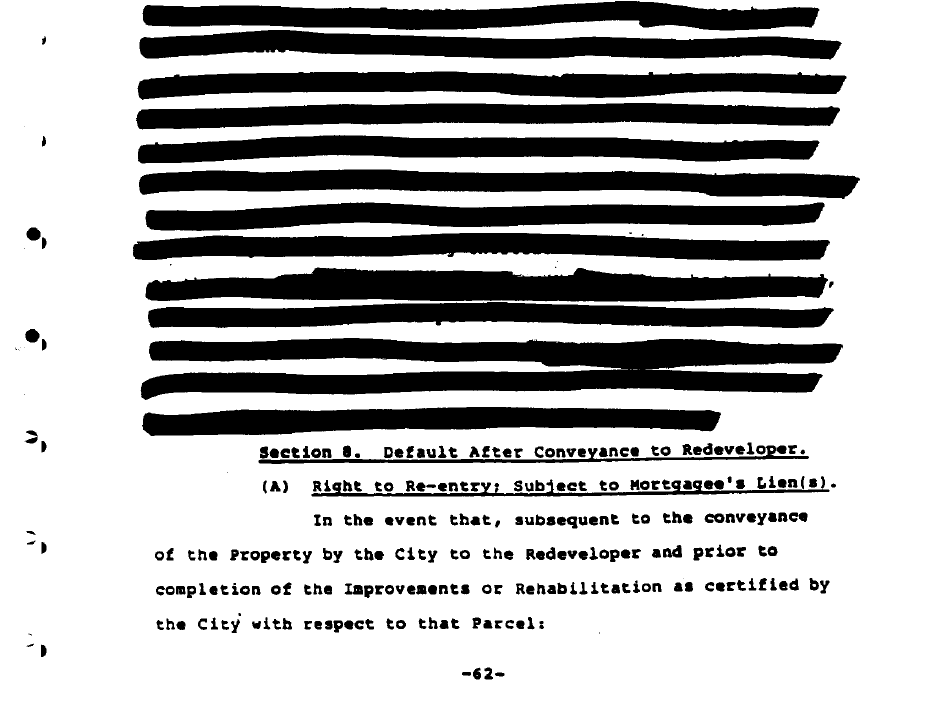


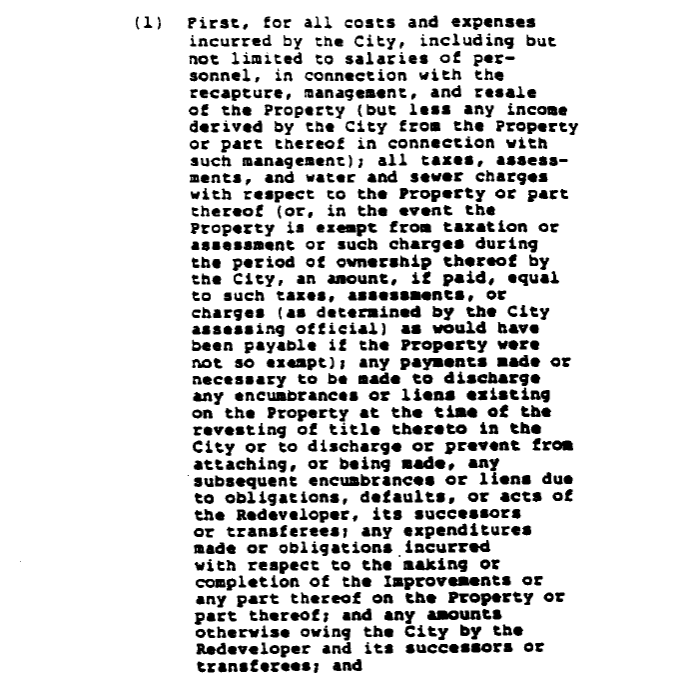


The Carabetta developer did none of the project, and the City held them in default. Unfortunately, the developer filed bankruptcy on July 29, 1992. If anyone asks why Asbury Park let the beachfront decay all through the 1990’s, tell them it’s because a Connecticut Bankruptcy Judge ordered Asbury Park not to touch its own beachfront – for the next 10 years!
The 2002 Plan and Agreement with Asbury Parters
The 1984 Plan has been amended more than a half dozen times over the years, but the most significant was on June 05, 2002 (known as Plan IV), shortly after the Carabetta bankruptcy ended.
In 2002 the Plan was expanded to 135 pdf pages. The Casino is now mentioned 37 times. The City’s intention to rehabilitate the Casino is still highlighted, to wit:
Page 16: “Restoration and/or adaptive reuse of historic structures such as the Casino
and Convention Hall.”
Page 18: “Create a nighttime entertainment district around the Casino.”
Page 28: “The historic Casino and adjoining Heating Plant are to be the center of entertainment activities that will extend out to the Palace and along Ocean Avenue
for one or two blocks. This development will take advantage of Wesley Lake and
the direct connection to the oceanfront. Opening the Boardwalk passage through
the Casino and lining it with retail and restaurant activities will encourage pedestrian mobility between Asbury Park and Ocean Grove. The land between the Palace and the Casino, which is presently comprised of excessive street pavement and vacant public property, has been identified as an ideal location for a hotel.”
Also Page 28:
· Anchor the Entertainment District with new uses within the restored
historic Casino and Heating Plant buildings
· Extend festive, beach-oriented retail uses along Ocean Avenue from the Casino to Convention Hall
· Extend “main street” commercial uses from the Casino to Cookman Avenue
· Develop a hotel opposite the Casino, at the western edge of the forecourt
· Link the Entertainment District to the Wesley Lake promenade
Page 34: “The Casino and Convention Hall will be renovated and will serve as focal
points for community events along the Boardwalk.”
Page 38: “The City’s Historic Preservation element identifies three buildings within the
Waterfront Redevelopment Area that are either listed or eligible to be listed
on the National Register of Historic Places: Convention Hall, the Casino/
Heating Plant and the Palace Amusement building. Renovation of historic
structures will be carried out in a manner that is consistent and in compliance
with all applicable Federal and State statutes.”
Page 40: “Under the Waterfront Redevelopment plan, the developer will acquire the Casino and Heating Plant from the City. These two buildings will be renovated and
form the core of the Boardwalk entertainment district described previously.”
Page 102: “Existing historic buildings within the waterfront redevelopment area,
including the Casino and Convention Hall, are planned for expanded roles
within the community.”
Page 105: “The Redevelopment Plan prohibits development on beaches except for certain unique situations, such as the renovation/restoration of the historic Casino/Heating Plant and Convention Hall, which both extend over the beach area.”
Keep in mind this is still the current operating plan, and it expires six years from now in 2032.
On October 28, 2002, with the Bankruptcy Judge’s required approval, the City entered into a new agreement with what is known in the contract as the “Master Developer,” Asbury Partners (the members of Asbury Parters have changed several times over the years, but it started with the Fishman Brothers and ended with iStar; iStar is now Safehold, Inc).
There are numerous time constraints in the 2002 agreement, but let’s limit ourselves to the Casino. Here is the only place in the contract referencing a timeline to redevelop the Casino, at page 39:
.3.5 Casino Property and Power Plant Property
Both the Casino Property and the Power Plant Property are COPS asdefined in Article 4 and are intended to be sold as provided therein.
The Master Developer shall have prepared a report by
an appropriate professional firm(s) reviewing the condition of eachproperty and recommendations for the rehabilitation, or demolition(limited to the rear of the Casino building) if necessary, -and the costsof renovation along with a detailed schedule. The report shall alsoaddress any environmental conditions known or suspected with regard to eachproperty.
The parties shall within 120 days of receipt of the above report, andprior to closing, agree to, said consent not to be
Rev. Eff. October 7> 2002 39
unreasonably withheld, a schedule of renovations to
be undertaken by the Master Developer after closing.
If the obligation of the parties to sell and purchase either the Casino Property or the Power Plant Property under the Casino Sale Agreement areterminated then the City shall have the right, but not the obligation, to sellthe same at public
auction on terms and conditions acceptable to the City.
Here is the summary of what we know from that part of the contract:
1. The developer has no right to demolish the entire Casino, just the rear part (the skating rink part on the sand that was already demolished)
2. An engineering report will be made detailing how the Casino will be redeveloped
3. BEFORE the Casino is bought by the developer, the City and the Developer will agree to a time schedule of the repairs contained in that report.
So what happened?
The report was issued on October 21, 2004 by the firm of Clark Caton Hintz. It is 281 pages of extensive detail outlining over $33 million in repairs, summed up on page 26:
COST ESTIMATE
Attached is a preliminary cost estimate for the renovation and reconstructionof the Casino which totals $33,614,000. This estimate includes the constructionof a new 3 story retail section (81,860 sf) in the location where the arenapart of the Casino now stands. The estimate includes restoration of theexterior and interior historic fabric of the building but does not includetenant fit-out costs.
The attached preliminary cost estimate is based on current floor area, volumeand other conceptual estimating techniques. As the design of the Casinoprogresses through the end of construction documents, the estimate will needto be updated and refined. The cost estimate which has been prepared by Clarke Caton Hintz and their cost consultant Becker & Frondorf represents thearchitect's judgment as a design professional familiar with the constructionindustry. It is recognized, that neither CCR nor Asbury Partners has controlover the cost of labor, materials o equipment, and final construction cost mayvary from this estimate.
So what didn’t happen?
There is no proof that the City and Asbury Partners agreed in a separate writing to the very important time schedule of repairs. In fact, this report was issued on October 21, 2004, and the closing took place 63 days later, on December 23, 2004.
Perhaps the proof of an agreed upon schedule is out there, but as of yet the City has not been able to supply one. It could be in a resolution, or a letter, or somewhere. Or perhaps it was never done.
Without a schedule of repairs, can the City still hold the developer in breach for not making the repairs? The answer is yes. First know that the plan has an expiration date of 2032. The plans and contracts all indicate the expectations of both parties was to develop the Casino before that time. Also, the contract has an “Abandonment” clause.
It’s on page 69 of the 2002 contract:
8.1 Abandonment, Notices
A. Abandonment of any part or portion of the Project by Master Developeror Subsequent Developer shall mean the failure to adequately staff ordiligently prosecute the Project to ensure the achievement of the Project.
Clearly, not touching the Casino for 24 years of a 30-year plan is an “abandonment” of the project. Inquiring about a demolition permit for part of the Casino that the contract says can’t be demolished, is a breach of contract for abandonment.
Next, here are the remedies for the default, right from the 2002 contract. To summarize, the City has the following rights:
If construction has not begun…
1. The City can repurchase the property for the amount the developer paid
2. The City can sell the property to a new sub-developer
If construction has begun…
1. The City can repurchase the property for the amount the developer paid for the property, plus hard costs the defaulting developer put into the property
2. If the defaulting party is a sub-developer (like Madison Marquette) the Master Developer (Asbury Partners) has the right of first refusal to purchase the property and sell it to a new sub-developer.
3. The City retains the right to cancel the redevelopment rights of the Master Developer and the sub-developer as to that property.
The following is photos of the contract language, proving the above. If you wish to skip the legalese, scroll down to the next section:


THE 2010 SUB-DEVELOPER CONTRACT
In the 2002 contract, the Master Developer Asbury Parters has the right to contract sub-developers for any property in the redevelopment zone.
That brings us to Madison Marquette. They started working in Asbury Park in 2006, but they formalized their agreement in a 2010 contract to develop all the beachfront properties.
A quick aside about Madison Marquette, to know who they really are.
There is a larger company based in Switzerland called Capital Guidance. They are an ENORMOUS international private equity firm that operates in 8 business sectors in many countries all over the world. Their true size is unknown because they are not on any public stock exchange.
Madison Marquette is NOT a separate company; rather they are a Capital Guidance realty holding company for just their US properties. Capital Guidance is on record stating Madison Marquette alone is worth over $6 billion dollars. They could have used their own money to repair all their Asbury Park buildings long ago. But they refuse … more on that later.
The first key point in the 2010 contract appears in the “Recitals,” Part D on Page 1, which sets out the agreed-upon background facts. It states that Madison Marquette and Asbury Partners are operating as a “joint venture.” Legally, this means that rights and obligations that apply to one party apply to the other as well, unless the contract specifically states otherwise.
MM is therefore bound with Asbury Partners by the prior 2002 contract on issues not covered in the subsequent 2010 contract. You will see later that the “joint venture” designation becomes vital to a Court deciding the obligations of these companies.
Later we will also look at two more 2010 contract provisions that explicitly state that both companies are obligated to the 2002 agreement regarding the Casino.
In the same “Recitals” section, Part H page 2 states that the developer intends to develop the properties “pursuant to Plans heretofore or hereafter to be provided to the City.”
That “heretofore” language is vitally important. The parties to the contract incorporated the 2002 plan into the 2010 contract (it does so several more times).
The parties memorialized that the obligations of the Waterfront Redevelopment Plan remain extant. In section 4.01(a)(i) it states:
Development Schedule. (i) MA Retail shall have the right to own, use, repair and maintain the RetailProperties in accordance with the Waterfront Redevelopment Plan and Applicable Laws and to develop the Retail Properties in accordance with the Waterfront Redevelopment Plan and an applicable subsequent development agreement.
It’s right there, plain as day: The parties intention was for the Casino to be developed as stated in the 2002 Plan. Madison Marquette may argue that they have the “right” to develop the Casino, but not the “obligation.” That is until we read the following paragraph, 4.01 (a)(ii), which says they have an “obligation” to fulfill the 2002 plan. See below.
As shown below, the Casino and Power Plant aren’t governed by the 2010 Agreement, rather they continue to be governed by the 2002 Agreement.
In the section headlined “Definitions,” which are not governing provisions but explanatory provisions, the following are “Retail Properties:”
"Retail Properties" means the Casino Property, the CH/PT Property, thePavilion Properties, the Power Plant Property and the Green Acres Parcels, all as more particularly described on Exhibit K attached hereto. The RetailProperties do not include any property north of Block 227, Lot 1.22.
That section includes all the boardwalk buildings from the Power Plant to the south up to the Sunset Pavilion to the north (Lot 1.22 is a green acres lot north of the Sunset Pavilion).
This means the parties knew all the boardwalk buildings, including the Casino, are “Retail Properties.”
But when we look at the governing provisions, this is where it gets interesting. Instead of just saying all “Retail Properties” are included, the contract lists individual properties governed by this 2010 agreement and specifically leaves the Casino out of it.
I’m pasting “section 4.01 (a) (ii)” for accuracy:
“(ii) This Agreement shall govern the rights and obligations of MA Retail relating to the 1stAvenue Pavilion Project, the 3rd Avenue Pavilion Project (as to use in its present condition), the 5th Avenue Pavilion Retail Project and the CH/PT Project, each of which MA Retail has commenced prior to the effective date of this Agreement, as well as the undertaking of the reconfiguration and beautification of the existing structure on 4th Avenue Pavilion Property and the demolition and right to reconstruct the structure on the Sunset Avenue Pavilion Property. In addition, this Agreement shall govern MA Retail's obligations related to the Band Shell Project and the construction of the New Lifeguard Facility and other obligations related to the WRA and the operation of the Entire Boardwalk.”
Two points jump off the page:
1. The Casino and Power Plant are left out of the properties that are governed by this 2010 agreement.
2. The final sentence acknowledges that MM has “other obligations related to the WRA.” The WRA (Waterfront Redevelopment Agreement) is the 2002 agreement. The 2010 agreement is titled as the SDA (Subsequent Developers Agreement).
Therefore, section 4(a)(ii) makes clear the Casino is not in this 2010 agreement but is still governed by the 2002 agreement, and Madison Marquette is “obligated” to finish it.
This isn’t the only time the contract makes that clear. Recall from above that Part H, page 2 states that MA Retail intends to develop the properties “pursuant to Plans heretofore or hereafter to be provided to the City.”
There is yet another section memorializing that MM remains obligated to perform the “Waterfront Redevelopment Plan” and incorporates the 2002 plan into the contract, which includes the redevelopment of the Casino:
3.02 Covenants and Restrictions of MA Retail.
(a) MA Retail shall comply with the applicable provisions and publicpurposes of the Act and shall at all times construct and develop the RetailProjects or cause the Retail Projects to be constructed and developed pursuantto the conditions and requirements of the Waterfront Redevelopment Plan, including, but not limited to, those provisions restricting the permitted uses established therein (which shall be a covenant running with the land).
That part in parentheses is very important. “Run with the land” means even a subsequent owner would have the same responsibilities to rehabilitate the Casino. That’s how important the City viewed Casino development to be.
All of that by itself is enough to show the parties intended the Casino still be governed by the 2002 agreement. But there is more…
As further proof that leaving the Casino out of the 2010 agreement was intentional, please see how every other building and property has its own section regarding construction obligations, starting at page 27:
4.02 is Lifeguard Facilities
4.03 is Beach Utility Connections
4.04 is Public Restroom Facilities
4.06 is Pavilions, and there are subparagraphs for each of the 1st Avenue Pavilion, the 3rd Avenue Pavilion, the 4th Avenue Pavilion, the 5th Avenue Pavilion the Band Shell and the Sunset Pavilion
4.07 is the Green Acres Parcels
4.08 is the Convention Hall/Paramount Theater Project
4.09 is the Beach Clubs.
4.10 is Bradley Park
The Casino and the Power Plant have no section on construction obligations, under the 2010 contract, because the incorporated 2002 agreement still governs. If the Casino and Power Plant was just left out of 4 (a)(ii) or just left out of the specific sections of Article 4, a Court might entertain an argument for mutual mistake. That they are left out of both is clear evidence of intention.
The paragraph that follows, again in section 4.01, part (iii), is likely what Madison Marquette will rely upon to claim that the Casino is not subject to the 2002 agreement. It states:
(iii) The Parties agree that the future undertaking of each of (i) the 2nd Avenue Pavilion Project, (ii) the potential demolition of the existing structures and reconstruction of permitted structures on the 3rd AvenuePavilion Property, the 4th Avenue Pavilion Property and the Sunset AvenuePavilion Property, (iii) the Casino Projects and (iv) the Power Plant Projectshall require subsequent development agreements prior to the right toCommence Construction and the obligation to undertake these projects arise; provided however, that MA Retail shall retain the right to occupy, use, repair and maintain the properties in accordance with the provisions of the Waterfront Redevelopment Plan and Applicable Law.
This one sentence indicating there will be a subsequent agreement for the Casino stands in contrast to the many provisions of this contract that states the 2002 Plan is incorporated into the 2010 agreement. It also stands in contradiction to itself in the last line which requires them to complete the Waterfront Redevelopment Plan, Casino redevelopment included, by 2032.
So what does a New Jersey Court do when there are contradictory provisions in a contract?
The Court uses a “Whole Document Approach.” What that means is the Court will try to decide which of the competing paragraphs was truly intended by the parties, by looking at the “whole document” rather than looking to one line or paragraph.
Also, when there are contradictory provisions in a contract, the Court will entertain “extrinsic’ or “parole” evidence to determine what the contracting parties actually wanted. That means the Court can look at matters outside of the contract language for proof.
So let’s take a look.
We begin with two later provisions in this 2010 contract that vitiates 4.01(iii) and further proves the parties intended the Casino be governed by the 2002 agreement, and not any other.
First, the contract makes clear to Madison Marquette that if a development obligation is not covered by the 2010 agreement (MM agrees the Casino is not) then the obligations in the 2002 agreement still governs.
Article 7.01 (a) states in pertinent part at page 42:
“Further, by this Subsequent Developer Agreement, (i) MA Retail assumes the obligations set forth in the Redeveloper Agreement and the Waterfront Redevelopment Plan with respect to the Retail Properties, but only as and to the extent such obligations are expressly set forth in this Subsequent Developer Agreement,and the City expressly consents to such assumption, and (ii) the City releases Asbury Partners from the obligations set forth in the Redeveloper Agreement and the Waterfront Redevelopment Plan with respect to the Retail Properties, but only as and to the extent such obligations are expressly set forth in this Subsequent Developer Agreement."
Madison Marquette now claims they DID NOT ASSUME THE RESPONSIBILTY for redeveloping the Casino because it is not in the 2010 contract. Therefore the Master Developer (Asbury Partners) is NOT released from its obligations of the 2002 agreement to develop the Casino.
Remember that part way back at the beginning that says Madison Marquette and Asbury Partners are in a “joint venture?” Now it’s clear why that is so important. One company is responsible for the obligation of the other. Asbury Partners and Madison Marquette are jointly responsible for the 2002 plan and contract. The Master Developer still has the obligation.
As if that wasn’t enough, the parties made the same point a second time later in the 2010 contract. Let’s look at Section 15.09 at page 54:
15.09 Conflict with Redeveloper Agreement. To the extent that the rights and responsibilities of MA Retail and obligations of the City contained in this Subsequent Developer Agreement are inconsistent with the rights and responsibilities of a Subsequent Developer or the obligations of the City as set forth in the Redeveloper Agreement, then provisions of this Subsequent Developer Agreement shall govern.
Madison Marquette’s position is that the 2010 agreement does not speak to obligations regarding the Casino. With no language to conflict with the 2002 agreement, the 2002 agreement still governs.
Those provisions alone will carry the day in Court. But in case the Court wants to do a “whole document analysis” let’s do it now.
On the one side of the Scales of Justice for the developer will be that one sentence that says Madison Marquette can ask for another agreement. But they didn’t. The Court won’t analyze a fictional contract that doesn’t exist.
MM will also have to deal with the “Doctrine of Laches” which states if you sit on your rights too long, you lose them. Together the developers have left the Casino untouched for 24 years, and the plan expires in 6 years. Then they sought a demolition permit. That triggers the “Abandonment” clause in the contract and the doctrine of laches.
Here is what will be on the other side of the scale for the taxpayers of Asbury Park. Let’s see if it is weightier than the developer’s one, oft contradicted line:
1. The 1984 Waterfront Redevelopment Plan calls for the Casino to be redeveloped, and mentions it 12 times, complete with construction expectations and drawings. It even indicates what the business uses will be and what kind of tenants it will have.
2. The 2002 Waterfront Redevelopment Plan calls for the Casino to be redeveloped, and mentions it 37 times, complete with construction expectations and drawings. It even indicates what the business uses will be and what kind of tenants it will have. All of that is incorporated into the 2010 agreement by reference.
3. Prior to 2010, there was a 2007 agreement, memorialized in a City Resolution, that is appended to the 2010 agreement. It authorized the involvement of Madison Marquette. In it, the parties agreed this would be the redevelopment plan for the Casino:
The Casino building will be built out as per the requirements in the Cafra permit. TheCarousel building will become home for a "Festive Market" themed to host "Best of NewJersey" type concessions. These concessions will sell everything from fresh fruits andvegetables to coffee and deserts to sandwiches and specialized ethnic fare to souvenirsand artistic ware. This will become a major destination point for local residents and touristsalike. Special short term parking areas will be constructed to accommodate the retail traffic.
The Arena section of the Casino will become a three story retail/entertainment complexwith great retail on the first floor, restaurants on the second floor and a nightclub on thethird. Depending on Cafra regulations an observation tower is also envisioned attachedto the structure;
The Arcade between the two buildings will be used by the public to traverse the boardwalk aswell as to gain entry to the retail establishments. Vertical transportation devices will be placed in the Arcade for use by the public to gain 2nd and 3rd floor access.
The power plant will be leased to a restaurant operator and renovated as per the Cafra permit.
The above being appended to the 2010 contract allows an alternative position that the 2010 contract is itself an agreement with a Casino redevelopment plan, lacking only a construction schedule, but still subject to the 30 year plan expiration in 2032.
4. This next one looks the worst for Madison Marquette. In 2024 they received a grant from the State of New Jersey (as sub-grantee to Asbury Park) of $13 million to make repairs to the Convention Hall Complex, specifically the Paramount Theater. Put aside that this money was supposed to be spent on COVID related losses under federal grant guidelines (the money was supplied by the US government under the American Rescue Plan Act).
To get that money, they had to apply for the grant. In that application, Madison Marquette tells New Jersey that if they get this grant for Convention Hall, that frees up money for their other redevelopment projects they have on Asbury’s boardwalk, and they name the Casino specifically. They go even further – they detail their Casino redevelopment as follows:
Casino Building Complex – The Casino Building complex is being redeveloped to include
four complimentary components, coming together as a multi-faceted, year-round
entertainment, dining, specialty retail and food destination. Components include:
- The Carousel House – the ornate copper-clad rotunda overlooking Carousel Plaza and
Wesley Lake, and the entrance to Casino Hall, which is being renovated to feature a
5,000 sf. bar and café.
- Casino Hall – an historic 28,000 ft. vaulted-ceiling hall featuring a mix of destination
dining and a specialty food market.
- The Arcade – 12,000 ft of specialty retail and food shops lining the boardwalk that
runs through the enclosed soaring class atrium connecting Casino Hall and Casino East
(need better name).
- Stone Pony Summer Stage – the Stone Pony Summer Stage will be a 5,000-capacity
world class outdoor amphitheater located on the second level of a newly constructed
beachfront building with sweeping boardwalk and ocean views. The Summer Stage
builds upon the legendary Stone Pony and the operations of the indoor Convention
Hall and Paramount Theatre, establishing leverage with promoters who are seeking
to schedule a wider variety of artists in the region.
- Boardwalk Social – located on the beach level below the Stone Pony Summer Stage,
Boardwalk Social will feature 20,000 ft. of indoor and outdoor dining, entertainment, games and special events year-round.
“Is being developed.” That’s what Madison Marquette told the State about the Casino. Not to sound like a grammar nerd, but a Court will look to discern “intention” of words offered by their parts of speech. The phrase “is being developed” is a “passive present progressive (continuous) verb phrase.” It describes an action “currently in progress” that is being done to a subject.
How can Madison Marquette tell a Court work on the Casino requires a new contract, while telling New Jersey they are currently redeveloping the Casino so they can get free tax money for the project?
What Madison Marquette told the State supports the people’s position - that Madison Marquette is obligated to redevelop the Casino by the 2002 plan and contract. It would be fraud to ask the State to give free taxpayer money to support a contract obligation they don’t have.
5. During the application process for the above grant, In January of 2024 there were email exchanges between Mayor John Moor and Daniel Davidow, a consultant for Madison Marquette who was drafting the grant application. The blue portion is the Mayor’s question followed by Madison’s answer. It speaks for itself:
Financing: I see, and I could be wrong, all grants. What happens if youdo not get them or what you have applied for? Is any of MM's moneybeing used. The boardwalk grant has to be spent or encumbered by2026 which one? What is the total cost of your proposed renovationsjust for the Convention Hall complex which includes the ParamountTheatre, the Grand Arcade, and the Convention Hall. Will the GrandArcade have to be closed during any portion of the proposed 3 years?
"Between the Boardwalk Preservation Fund, the new tax creditprogram for arts facilities, and the State and Federal HistoricTax Credit programs, we are hoping for $50 million in cashsubsidy. The overall project cost estimate is currently at about$120 million. The remainder of the project (and thecasino/carousel building project not part of this discussion) would be privately financed by Madison Marquette.
The Boardwalk grant must be committed by the end of 2024 andspent by the end of 2026. It is considered committed when the City makes the grant award. We do not believe spending the cash by the end of 2026 this will be a problem.
It is almost certain that at some point(s) during the project, the Grand Arcade will have to be closed. Please see my response to the next question for more context."
Why is Madison Maquette talking to the Mayor about financing Casino redevelopment if the parties have no contract on Casino redevelopment? It’s because they do have a contract - the 2002 contract, and both sides know it.
6. The City made clear its position on Casino redevelopment when on January 12, 2023 they issued a Resolution holding MM in Default for not redeveloping the Casino. The rationale argues the same that I argue here – the 2002 Waterfront Redevelopment Plan is incorporated into the 2010 agreement. That default notice states in pertinent part:
Requirements related to the Casino and Power Plant Projects
WHEREAS, under Section 3.02(h) of the SDA, “MA Retail shall cause all of the Retail Projects to be developed, financed, constructed, operated, and maintained at its sole cost and expense (other than contributions by tenants, licensee, vendors, etc.) and at no cost or expense to the
City”; and,
WHEREAS, the Casino Project is defined by the SDA as the project for the redevelopment of the Casino Property, located at Block 227, Lot 1.04; and,
WHEREAS, the Power Plant Project is defined by the SDA as the project for the redevelopment of the Power Plant Property, located at Block 227, Lot 1.03; and,
WHEREAS, MA Retail has failed to develop, finance, operate and maintain the Casino and Power Plant Buildings and both buildings have been permitted to languish and fall into a state of disrepair; and,
WHEREAS, under Section 3.02(i), MA Retail has an obligation to adhere to the vision of the Casino and Power Plant Projects that is presented in the Waterfront Redevelopment Plan; and,
WHEREAS, the Waterfront Redevelopment Plan includes many references as to the Casino and Power Plant (referred to as the “Heating Plant” in the Waterfront Redevelopment Plan), including, inter alia, the requirement that MA Retail renovate, adaptively reuse and create entertainment activities therein; and,
WHEREAS, under Section 3.02(j) of the SDA, MA Retail has an obligation to use commercially reasonable efforts to diligentlyundertake the construction, development, operation, and maintenance of the Power Plant Project and Casino Building and achieve Completion of Construction on such project; and,
WHEREAS, MA Retail has breached section 3.02(i) of the SDA by failing to develop, finance, construct, operate and maintain the Casino and Power Plant in accordance with the Redevelopment Plan; and,
WHEREAS, MA Retail has discontinued performance of its obligations under the SDA causing
“commercial frustration” of its purpose, and thus, has violated Section 3.02(h) of the SDA; and,
WHEREAS, MA Retail has failed to diligently construct, develop, operate and maintain the Power Plant and Casino Buildings, and thus, has violated Section 3.02(j) of the SDA;
3.C.21
Thereafter, the Default Resolution sums up the above:
(1) Failure by MA Retail to meet their obligations to use commercially reasonable efforts to diligently undertake the construction, development, operation, and maintenance of the Casino Building and achieve Completion of Construction on such project, as required by Section 3.02(j) of the SDA.
(2) Failure by MA Retail to cause the Casino Building to be developed, financed, constructed, operated, and maintained, as required by Section 3.02(h) of the SDA.
(3) Failure by MA Retail to develop, finance, construct, operate and maintain the Casino Building in accordance with the Waterfront Redevelopment Plan, as required by Section 3.02(i) of the SDA.
7. When the Court uses extraneous evidence to interpret a contract, that can include what the parties told a newspaper.
A search of Newspapers.com reveals Madison Marquette discussing their Casino redevelopment plans at least 9 times.
On September 29, 2007 The Star Ledger Spoke to Michael Walker, a former clothing designer Madison Marquette hired to design the building renovations in Asbury Park. Why a clothing designer and not an architect is weird but irrelevant. Micheal said this:

There is a statement made by Madison Marquette to a newspaper as well. On June 24, 2018, Gary Mottola, a senior executive with Madison Marquette, told the Daily Record the following:

Look closely at what Mottola said there. He said there is “no specific timetable” for the Casino redevelopment and “no specific order” to complete the boardwalk buildings.
Look closely at what he didn’t say. He didn’t say they aren’t obligated to redevelop the Casino. Only that the contract lacks a timetable.
As this work shows, there is a timetable. The Waterfront Redevelopment plan calls for Casino Redevelopment, and it is incorporated into the contracts. The contract expires in 2032, but the City need not wait that long to enforce default. The contract has an “Abandonment” clause, and that was triggered after 24 years of neglect and the request for a demolition permit.
Madison Marquette can’t point to any public pronouncement where they said they were not obligated nor actually developing the Casino.
Back to the Scales of Justice. Putting those 7 areas addressed above on one side, and on the other side that one line (repeatedly contradicted in the same contract) that MM could get a separate agreement for the Casino, it’s not even a close call. The scales will fall over from the weight of the People’s position.
There is another very compelling contract issue that favors the Peoples’ position.
The contract was completely frontloaded so that the developers would gain their benefit of the bargain first and begin making tens of millions of dollars. The People’s benefit, fully restored historic buildings, was backloaded so that the developers could first make their money to do it. The people delivered on all their contractual promises. They include, but are certainly not limited to, the following:
1. The Developers received the redevelopment rights for very little money. The Redevelopment zone is enormous – 56 acres comprising a mile stretch of beachfront and four blocks west. They paid through the bankruptcy court only $7.4 million, and $5 million was back taxes on Asbury properties they were now going to own.
2. Although not required, the City allowed the developers to negotiate a new plan and contract that would be more to their liking. In addition to the beachfront redevelopment, the new plan allowed them to build 3,200 condominium units.
3. The City amended zoning laws to accommodate the developer’s plans.
4. The developers were granted the right to have the City take houses and businesses by Eminent Domain so the Developer could acquire them. The Developer did this to families who were in Asbury Park for decades.
5. The City adopted a “Waterfront Tax Abatement Ordinance” for the redevelopment projects.
6. To ensure they were going to make money quickly, the first three very large condominium projects were “fast tracked” by the City, a process designed to eliminate red tape obstacles. Those projects were subcontracted out to large developers Hovnanian, Kushner and Paramount Homes.
7. The City gave the developers exclusive control of parking in the beachfront, where they have operated several lots for decades, with higher average parking prices than New York City.
8. The developer’s businesses and tenants were afforded the opportunity to take part in Urban Enterprise Zones for reduced taxes.
9. The developers were supposed to pay the infrastructure costs associated with their 3,200 condominiums. It was first estimated that it would cost $30 million (considering that they have individual units for sale for $9 million, it wouldn’t take long to recoup that).
The developers reneged. Due to the passage of time this bill ballooned to an estimated $80 million. The City then allowed a renegotiation, where they agreed that PILOTS would be granted. Under the agreement, the school tax money (about 50% of the average Asbury Park tax bill) would be diverted to the developer to pay back infrastructure costs (and the children pay interest on a Bond the City took to pay back the Developer). This has helped create a $13 million shortage in the school budget. In summary, the Asbury Park school children are giving the multi-billion-dollar private equity fund their infrastructure for fee.
Having taken full advantage of the above benefits, the developers have ignored for 24 years the one thing the People were to get under the plan and contracts – redeveloped historical buildings, including the Convention Hall and Casino.
Finally, the developer may also attempt to rely upon Section 8.02 of the 2010 agreement entitled “Defaults.” They will say the plain language indicates it replaces the Default provision of the 2002 agreement, and therefore the Casino cannot be retaken.
However, that’s just the introductory paragraph. When the actual default events are listed in 8.02 (c), and when read in pari materia with the definitions section, the Casino is still exempted from the 2010 Agreement, including Section 8. Section 8 of the 2010 contract will be voided as to the Casino by what is known as the “Doctrine of Impossibility.”
Let’s examine closely.
Note that the opening paragraph does NOT apply to the “Retail Properties,” and it easily could have stated that. The parties opted instead for the words “Retail Projects:”

Before we get to the section (c), the actual default events for failure to redevelop, we must go to the Definitions section to define some terms.
Under the Definitions section, “Retail Projects” does not include the Casino land or buildings, which have their own definitions such as “the Casino Property,” and “the Casino Arena, House, Arcade and Carousel ,” each being separately defined as the land and buildings.
Instead, “Retail Projects” more specifically includes “the Casino Projects.” That means the redevelopment plans and timelines. Here is the definition section exactly as written:

Now that we have the definitions, let’s look at what is an event of default in 8.01(c):

It says default is a failure to construct the projects in Article 4. It says nothing else.
As extensively discussed above, The Casino redevelopment and construction timeline was intentionally, purposefully, left out of Article 4.
How can default for failure to redevelop the Casino be dependent on a contract provision that intentionally leaves out redevelopment of the Casino? It can’t. It’s senseless and has no possible real-world application. In other words, it’s impossible. That’s why the Court will apply the “Doctrine of Impossibility”and rule that the 2010 Section 8 defaults apply only to the projects listed in Article 4, as written, of which the Casino is plainly not one of them.
All of that is in furtherance of the People’s position that sections 7.01(a) and 15.09 compel that the Casino redevelopment remain governed by the 2002 contract and Waterfront Redevelopment Plan. That contract allows the Casino to be retaken.
Conclusion
To accept Madison Marquette’s position, the Waterfront Redevelopment Plan could expire in 2032 with the Casino never being redeveloped. Thereafter it could continue to go undeveloped and remain shuttered forever. To accept Madison Marquette’s position, no company in the world is obligated to repair that building.
The history, the plans and the contracts say otherwise. The Master Developer Asbury Partners was not relieved of their obligations to redevelop and open the Casino. As a joint adventurer, Madison Marquette joined that obligation. They are responsible for Casino redevelopment, and their waiting 24 years of a 30-year plan, coupled with their demolition request, triggers the Abandonment Clause and the Doctrine of Laches.
Both companies already accepted the benefits of the contracts that were frontloaded for them. Equity requires that the people of Asbury Park receive their benefits under the same contracts and finally have the fully restored historic Casino complex they bargained for.
Recommendations:
1. The City should issue default notices.
2. The City should list the property and redevelopment rights for sale.
3. The City should file legal action per the 2002 agreement to take back the Casino.
Respectfully submitted to the public…
Thomas De Seno, Esq.
aka “Asbury Park’s Official Unofficial Historian”
aka “The Pope of Asbury Park”


👏👏👏 Well done, sir. Thank you for choosing to serve democracy and the common good. Shame on all the grifters. America! Where are you?
Glad to see someone finally stated who really owns the Asbury Park waterfront. Capitol Guidance. Cut to the chase, a Middle Eastern Company who could care less about Asbury Park, Jersey Shore culture. They would never get away with this for a European historical structure.
Thanks for plainly sorting this out.
yet another chapter in Private Equity Ruins Everything
Very enlightening. Obviously, there is always someone or someones who are benefiting from this delay in construction, and likely on the Asbury Park governing body side. Probably filtered through some “foundation”, LLC, or other money laundering scheme. It’s no secret that AP’s governing body has been corrupt for decades. How is it that the only town on the Jersey shore became a ghost town for decades?
Follow the money.